Which Way to Boonesborough?
by Randell Jones
All who wander may not be lost, but keeping everybody straight about what trail they are on has been a continuing challenge.
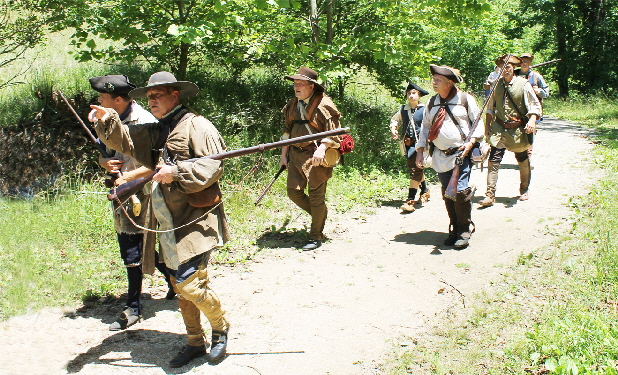
Boone Trace is 250 years old this spring. That’s when Daniel Boone, America’s pioneer hero, and a party of 30 axmen, or road cutters, blazed that path for others to follow during March and April 1775. These fellows—and two women camp keepers, it seems worth mentioning during National Women’s History Month—marked a path into the wilderness of Kentucky to arrive at a site along the Kentucky River, where they began to build Fort Boonesborough. This path sparked the beginning of America’s first westward movement, hand in hand, as it happened, with the beginning of the American Revolution. And the routes to arrive on this first expanding American frontier went by a few different names—and for good reasons.
A surprise to many Kentuckians and most everyone else is that Boone Trace is not the same as Wilderness Road. Boone Trace was marked in 1775 as a footpath for walkers, riders, and pack horses only. Those wanting to settle Kentucky by coming through the Cumberland Gap in wagons had to wait for two decades. It was 1796 when the Commonwealth of Kentucky, then only four years old, let a contract for others—not Daniel Boone—to build a wagon road. Also, Wilderness Road went to a different place, not to Boonesborough
Boone Trace—the most historically important path to the founding of Kentucky—started at the Long Island of the Holston in today’s Kingsport, Tennessee and followed a known route to the Cumberland Gap, a path Boone had followed during his many hunting trips into the Kentucky wilderness since 1769. After passing through Cumberland Gap, Boone and his party of road cutters followed the Great Warrior’s Path (“the path of the armed ones”), Athawominee/Athiamiowee, along Yellow Creek for the first 15 or so miles to cross the Cumberland River at Cumberland Ford in today’s Pineville, Kentucky. From there, they continued northwest along the Cumberland River to a place called Flat Lick.
The 1796 Wilderness Road went to Crab Orchard and eventually on to Louisville, but for those first 15 miles after crossing Cumberland Gap, the Wilderness Road followed Boone Trace, and also the Great Warrior’s Path all the way to Flat Lick. And that overlapping is probably the source of centuries-old confusion about what name goes with what route.
From Flat Lick, however, all three routes diverged. Boone Trace continued in a northwesterly direction. Wilderness Road turned west at Flat Lick and followed a primitive hunters’ trail, Skagg’s Trace toward Crab Orchard. The “path of the armed ones” Athawominee/Athiamiowee, continued as it had for over 12,000 years in a north-by-northeasterly direction to cross the Ohio River at the mouth of the Scioto River, at today’s Portsmouth, Ohio, to enter the homeland of the Shawnees. That ancient path is popularly regarded as having been trod by migrating herds of deer, elk and bison, which it was. However, modern researchers acknowledge it was trod for thousands of years by now-extinct mastodons. The commemorative plagues at the modern park in old Flat Lick in Knox County tell parts of this remarkable history of paths coming together and diverging.
The 250th anniversary of Boone Trace is commemorated during spring 2025 through the efforts of communities all along the route. You can even join in walking along daily segments of the entire 240-mile route during the “Pass the Axe” Relay Hike, beginning April 23 in Kingsport, Tennessee and ending June 7 at Fort Boonesborough State Park at the 2-day commemorative celebration of the 250th anniversary of the Settlement of Kentucky. Sign up now to participate.
Information about these events, including the Relay Hike, is available at BooneTrace250.com where you can also find the new video, “Boone’s America—Boone Trace, 1775,” produced by Randell Jones, author of the award-winning book, In the Footsteps of Daniel Boone. The 2nd edition was released in time for this celebration and includes 330 photographs, about half captured at historical reenactments during the last 20 years. The book puts Boone’s life on the landscape he trod during his remarkable 86 years, places which now are spread across 11 states. You can find more information about the route of Boone Trace through the membership-supported Friends of Boone Trace at BooneTrace1775.com. Your purchase of books and merchandise at any of the historical sites along the route helps these history-minded organizations preserve our history and tell our stories. Please support them and enjoy celebrating the 250th anniversary of Boone Trace.
Hope to see you on the trail—by any name.


© 2016 - 2026, ALL RIGHTS RESERVED
Friends of Boone Trace 1775
Website Maintained by Graphic Enterprises
